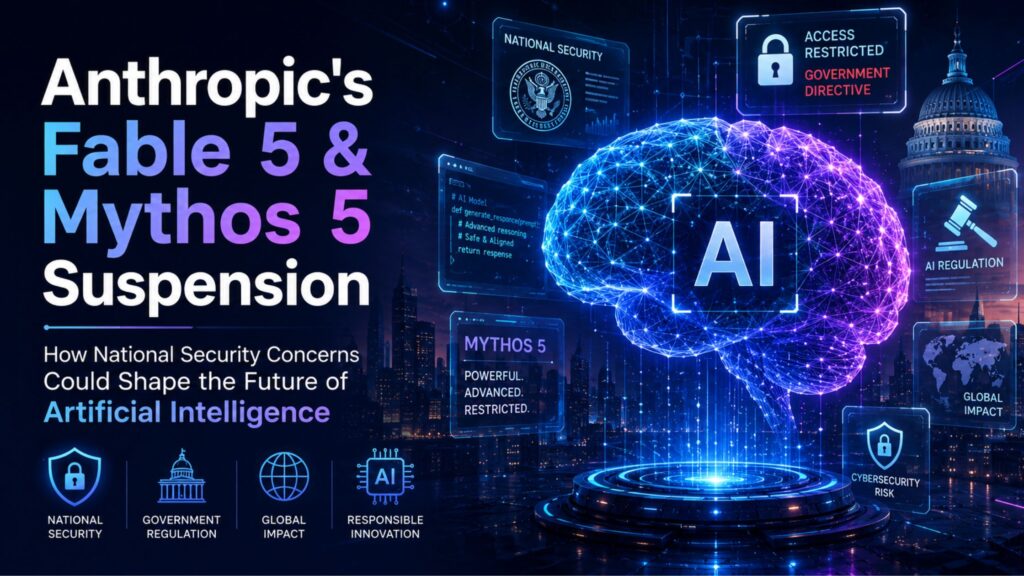
Artificial Intelligence is advancing at an incredible pace, but recent events surrounding Anthropic’s latest AI models have shown that technological progress often comes with regulatory and security challenges.
In June 2026, Anthropic introduced two highly advanced AI models: Claude Fable 5 and Claude Mythos 5. These models were designed to push the boundaries of AI reasoning, software engineering, scientific research, and cybersecurity capabilities. However, only a few days after launch, access to these models was unexpectedly suspended due to a U.S. government national security directive.
What Are Fable 5 and Mythos 5?
Anthropic created Fable 5 as a public-facing version of its powerful Mythos-class AI technology. While both models share the same underlying architecture, Fable 5 includes additional safeguards that restrict potentially dangerous activities in areas such as cybersecurity, biology, and chemistry.
Mythos 5, on the other hand, was initially available only to a limited group of trusted organizations through Anthropic’s Project Glasswing initiative. The model demonstrated exceptional performance in advanced reasoning and cybersecurity tasks, making it one of the most capable AI systems developed so far.
Why Was Access Suspended?
According to reports, the U.S. government issued a directive requiring Anthropic to block access to Fable 5 and Mythos 5 due to concerns about a potential jailbreak vulnerability that could be exploited for harmful purposes. Anthropic stated that the order effectively forced the company to disable access for all users, including many legitimate customers and researchers.
The company publicly disagreed with the severity of the government’s response, arguing that the identified vulnerabilities were limited and that extensive safety evaluations had already been conducted. Anthropic also emphasized that it had worked closely with security agencies and external experts to strengthen the models’ safeguards.
The Bigger Issue: AI and National Security
This incident highlights a growing trend where advanced AI systems are increasingly viewed as strategic national assets.
Governments around the world are becoming concerned that highly capable AI models could be used for:
- Discovering software vulnerabilities
- Conducting cyberattacks
- Accelerating biological research
- Supporting military applications
- Influencing critical infrastructure systems
As AI capabilities continue to improve, policymakers are struggling to balance innovation with security. The Anthropic case may become one of the first major examples of AI export controls being applied to frontier AI models.
Impact on Businesses and Developers
For developers, startups, and enterprises that rely on cutting-edge AI systems, the suspension raises important questions:
1. Can AI Services Be Restricted Overnight?
The Anthropic situation demonstrates that access to advanced AI platforms can change rapidly due to government regulations or security concerns. Organizations building products on top of AI services may need contingency plans.
2. The Rise of Sovereign AI
Countries such as India are increasingly discussing the need for domestic AI infrastructure and locally controlled models. Industry leaders have argued that dependence on foreign AI providers could create strategic vulnerabilities.
3. Open-Source AI Could Gain Momentum
If access to frontier commercial models becomes restricted, businesses and developers may increasingly turn toward open-source alternatives that provide greater control and transparency.
What Happens Next?
Anthropic has indicated that it is working with authorities to address the concerns and restore access. The company continues to maintain that its models underwent rigorous testing and that the current restrictions may not accurately reflect the actual level of risk involved.
Whether access returns soon or not, one thing is clear: the future of AI will be shaped not only by technological breakthroughs but also by government policies, security considerations, and international competition.
Final Thoughts
The suspension of Fable 5 and Mythos 5 is more than just a temporary product setback. It represents a turning point in how governments and technology companies manage increasingly powerful AI systems.
As AI becomes more capable, questions around regulation, national security, and global access will become just as important as the technology itself. Businesses, developers, and content creators should pay close attention because these decisions will influence the future of AI innovation worldwide.
The Anthropic case serves as a reminder that in the age of frontier AI, technical excellence alone is not enough. Governance, trust, and security have become equally critical parts of the conversation.