
Type a question into ChatGPT, Google AI Overviews, or Perplexity, and you get something that feels almost magical: a clear, synthesized answer, written just for you, often with sources cited underneath. But there’s nothing magical about it. Under the hood, AI search engines run on a fairly mechanical, three-part process — and understanding it is the whole foundation of Answer Engine Optimization (AEO).
Here’s what’s actually happening between the moment you hit enter and the moment an answer appears.
1. Two Sources of Knowledge: Training Data and Real-Time Retrieval
Every AI search engine draws on two very different pools of information.
Training data is the massive snapshot of the internet baked into the model before it ever launches. It’s static — it doesn’t update in real time, and it’s typically refreshed only every several months. If you ask a model something purely from memory, yu’re asking it to answer from this frozen snapshot.
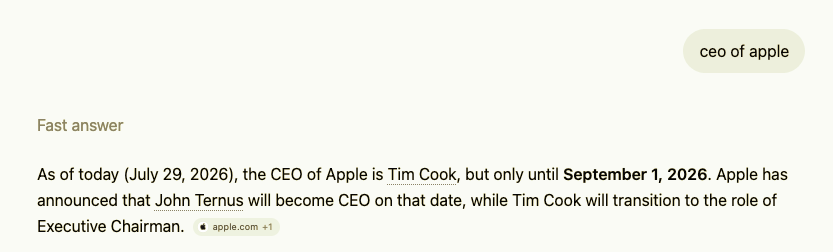
Real-time retrieval is the fix for that limitation. This is where Retrieval-Augmented Generation, or RAG, comes in. Instead of relying solely on what it memorized during training, the model goes out to the live web, knowledge bases, or specialized databases, pulls back current information, and uses that material to write its answer. This is the layer that lets an AI tool answer questions about this week’s news, a product that launched last month, or your company’s latest blog post.

RAG exists largely to prevent hallucination. When a model is asked about something it has no reference for, it’s most likely to guess — and guess wrong. Giving it live source material to ground its answer in is what keeps it honest.
Practically, this means your brand has two separate ways to show up in AI search: through consistent mentions across independent sources over time (which shapes what ends up in training data), and through well-structured, crawlable content that can be fetched and cited in real time.
2. Query Fan-Out: One Question Becomes Many
Here’s the part most people don’t realize: AI search engines almost never search for your exact question.
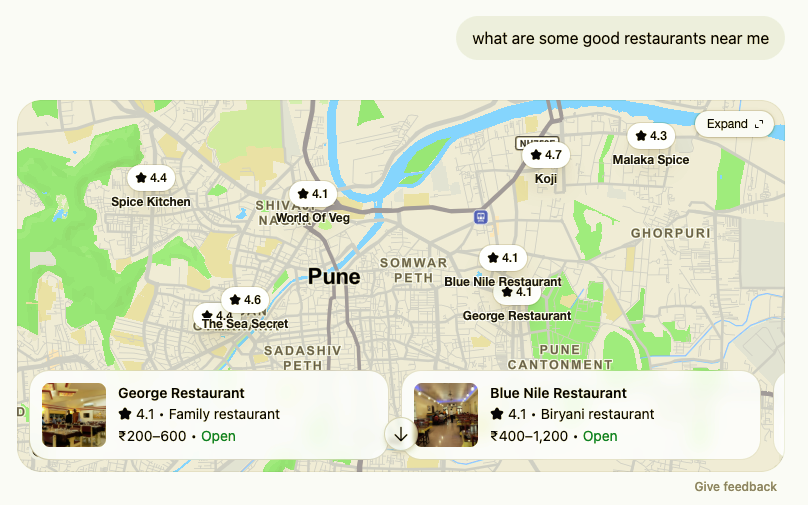
Long, conversational prompts don’t perform well against classic search infrastructure, so the system breaks your prompt apart into several shorter, more targeted sub-queries — a process known as query fan-out. Ask ChatGPT “what are some good restaurants near me,” and it might quietly rewrite that into something like “top restaurants San Francisco” based on your location, then fire off several more sub-queries covering price, cuisine, and reviews.
This isn’t a minor detail — it’s the core reason single-page optimization matters less in AI search than it did in traditional SEO. A typical prompt can generate somewhere in the range of 9 to 11 sub-queries, and complex ones can generate dozens; some deep-research modes have been documented running hundreds of searches for a single request. All of those sub-queries run in parallel, hitting the live web, knowledge graphs, and specialized databases simultaneously, so the response doesn’t take forever to generate.
The upshot for anyone trying to get cited: an AI system isn’t just checking whether one page ranks for one keyword. It’s assembling evidence from dozens of angles on a topic. Being mentioned broadly and consistently across the web — not just ranking for a single query — is what gets you pulled into that evidence pool.
3. Chunking, Embedding, and Synthesis
Once the fan-out queries return results, the AI doesn’t just read whole pages and pick a favorite. Each retrieved document gets broken down and processed:
- Chunking — long pages are divided into smaller, semantically coherent passages, rather than being treated as one giant block of text.
- Embedding — each of those passages is converted into a high-dimensional vector representation, which is essentially a mathematical fingerprint of its meaning.
- Synthesis — the model reviews everything retrieved across all the sub-queries, looks for overlap and agreement between sources, and weaves the strongest, most corroborated points into a single, coherent answer.
This is why AI search results often feel less like “here are ten blue links” and more like a briefing someone put together for you. The fan-out and synthesis steps are doing the work of turning scattered fragments of the web into something that reads as intentional and complete.
It’s also why the underlying retrieval layer usually isn’t unique to the AI product itself. Google Gemini and AI Overviews lean on Google Search, Microsoft Copilot uses Bing, ChatGPT draws on both, and other assistants route through search partners of their own. In other words, most AI search tools are sitting on top of traditional search infrastructure — which is part of why getting indexed by a regular search engine is still a prerequisite for showing up in an AI-generated answer, not a separate, disconnected game.
Why This Matters
Put the three pieces together and you get a fairly clear picture of what it actually takes to be “AI search optimized”:
- Be present in training data — through durable, widely-referenced mentions across independent sources, not a single push.
- Be retrievable in real time — through content that’s crawlable, well-structured, and easy for a system to chunk and extract meaning from.
- Be relevant across the fan-out — by covering a topic thoroughly enough that you show up across the many angles a system might sub-query, not just one exact-match keyword.
AI search isn’t replacing the mechanics of search or SEO so much as adding a synthesis layer on top of them. The engines still have to find, index, and retrieve content the way they always have they’re just now assembling it into a single conversational answer instead of a list of links. Understanding that pipeline is the starting point for figuring out how to get cited in it.

Pingback: How to Track AI Traffic in GA4 and Ahrefs Web Analytics (ChatGPT & More) - AI360 Central